
WELCOME BONUS 300%
UP TO €2000 + 100
FREE SPINS
UP TO €2000 + 100
FREE SPINS
Home → Blackjack
Blackjack at Bonanza Casino
What the Peek Means When the Dealer Shows an Ace
Peek describes the dealer checking the hole card when the upcard is an ace, and the rule affects Blackjack Insurance with 6 to 8 decks. The insurance side bet carries an RTP of 92.53% and a house edge of 7.47%, which is far worse than the 0.46% edge on the standard six-deck game with S17, DAS and DOA. A player staking €100 on insurance over many hands loses €7.47 on average per bet.
Basic strategy always declines insurance except for card counters at a true count of +3 or higher, because the 2:1 payout does not compensate for the true probability. The side bet is limited to 50% of the main bet when the dealer shows an ace. On a €100 main bet, the maximum insurance stake is €50, and a winning insurance bet pays €100 at 2:1.
The effect of the peek is that the dealer resolves the blackjack before players act on their hands, which protects additional split or double stakes. With a single deck, the insurance edge is approximately 5.88%, still far above the 0.46% of the main game with basic strategy. A player who never takes insurance keeps the lower house edge of the standard blackjack game instead of the 7.47% of the side bet.
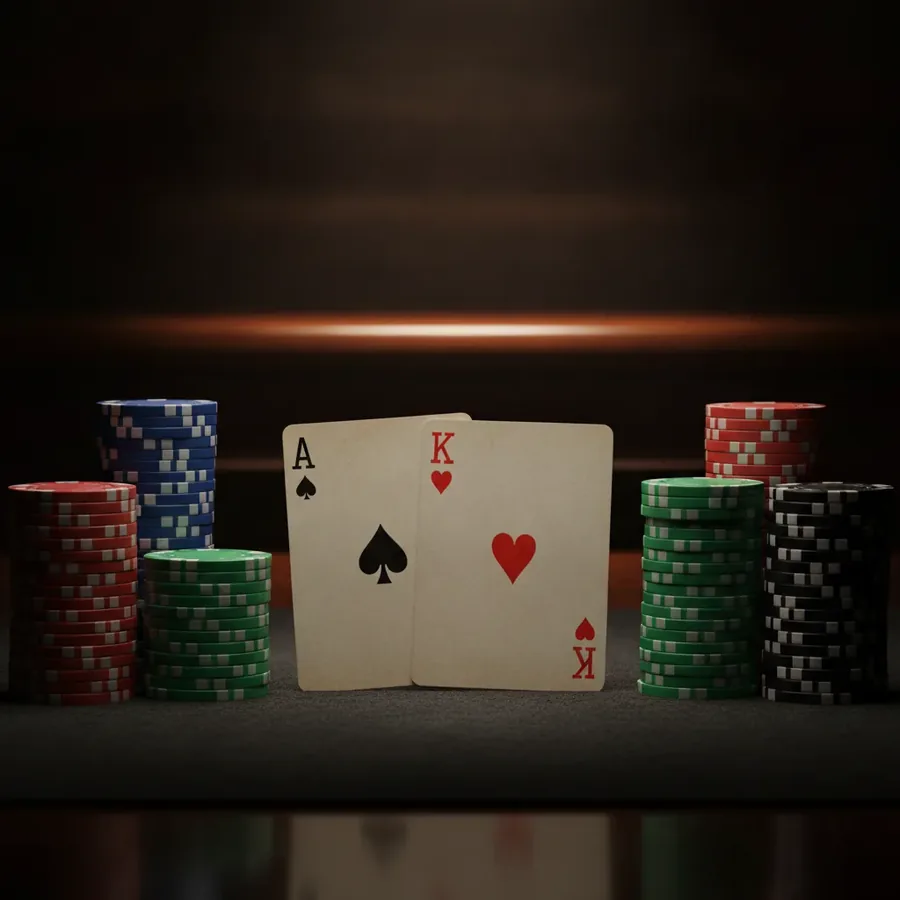
RNG Deals From a Virtual Eight-Deck Shoe
The RNG blackjack game with six decks, S17, DAS and DOA returns 99.54% with basic strategy, giving a house edge of 0.46%. The rule set includes the dealer standing on soft 17, doubling on any first two cards, and doubling after a split, but no surrender. A blackjack pays 3:2, so a €100 stake returns €150 on a natural.
Fewer decks reduce the edge by about 0.48 percentage points compared with eight decks. The liberal Vegas Strip rule set returns 99.72% with late surrender, resplit and DAS.
A 6:5 payout on a six-deck game lowers RTP to 98.15% and raises the house edge to 1.85%, adding exactly 1.39 percentage points to the casino's advantage. On a €10 bet, a blackjack pays €12 instead of €15 under 6:5. The rule change costs €3 per natural blackjack compared with the 3:2 payout, which is the largest single rule penalty in the list.
Bet Two Percent of Your Bankroll per Hand
A two percent flat stake on a €1,000 bankroll means €20 per hand, and the six-deck game with S17, DAS and DOA has a house edge of 0.46%. Over 100 hands at €20 each, the total stake is €2,000 and the expected loss is €9.20 at the theoretical edge. The RTP of 99.54% means the player keeps €1,990.80 of the €2,000 on average.
The stake rule interacts with the 6:5 payout game, where the house edge is 1.85% and RTP is 98.15%. On the same €20 hand, the expected loss per hand is €0.37 instead of €0.092 in the 3:2 game with basic strategy. The difference of 1.39 percentage points makes the 6:5 game four times more expensive per hand than the standard six-deck game.
Live tables show different bet ranges: Lightning Blackjack from Evolution accepts €1 to €2,500 per hand, while Infinite Blackjack and Quantum Blackjack Plus Live allow €1 to €5,000. A two percent bankroll rule on a €10,000 bankroll produces a €200 hand, which fits within all three live ranges. The live RTPs are 99.56% for Lightning Blackjack and 99.57% for Quantum Blackjack with optimal strategy.
Ignoring the Basic Strategy Chart: 1 Percent Wasted
Ignoring basic strategy on the six-deck game with S17, DAS and DOA pushes the house edge from 0.46% toward the 1.85% of the 6:5 payout variant, a swing of 1.39 percentage points. The RTP drops from 99.54% to 98.15% when a player abandons the chart and takes the 6:5 payout instead. On 100 hands at €10, the expected loss rises from €4.60 to €18.50.
The insurance side bet shows a far larger penalty: the RTP of 92.53% and house edge of 7.47% mean that a player who takes insurance on a €100 main bet with a €50 side bet loses €3.74 on average per insurance bet. Over 100 such side bets, the total expected loss is €374, compared with €46 on the main game with basic strategy.
Rule modifiers quantify the cost of deviations: dealer hitting soft 17 adds 0.22 percentage points to the edge, while resplitting aces improves it by 0.08 points and doubling after a split improves it by about 0.14 points. Late surrender is worth 0.08 points to the player. A player who ignores all player-favourable options gives up roughly 0.30 percentage points against the 99.54% baseline.
No Doubling Down on Three Cards
Blackjack players cannot double down on a three-card hand under the standard six-deck rules with S17, DAS, DOA and a 3:2 payout. This variant carries an RTP of 99.54% and a house edge of 0.46%, and it permits doubling only on any first two cards. A third card closes the doubling option, so a player who hits to a total of 11 and then draws a low card is limited to a regular 1:1 win or a loss.
The restriction is tied to the DAS rule, which allows doubling after a split but only on the first two cards of each split hand. Compared with the liberal Vegas Strip rule set, which reaches an RTP of 99.72% and a house edge of 0.28%, the six-deck game gives back 0.18 percentage points of return because it also omits late surrender. On a €100 stake, the average cost rises from €0.28 to €0.46.
The house edge of 0.46% assumes a player follows basic strategy, and the inability to double on three cards is part of that baseline. A player who doubles on a three-card hand against the rules would not change the published RTP. The 6:5 payout variant, which replaces 3:2 on six decks, lifts the house edge to 1.85% and costs €3 on a €10 blackjack, a far larger penalty than the three-card restriction.
Blackjack variants at a glance
| Variant | Payout | House edge | Rule | RTP |
|---|---|---|---|---|
| Blackjack Surrender (late surrender) – rule effect | 50% of the stake returned | −0.08 percentage points | The player gives up the hand after the dealer has checked for blackjack and loses half the stake. Improves RTP by about 0.08 percentage points. Early surrender is worth much more (up to −0.6 percentage points) but is extremely rare. | n/a (rule modifier) |
| Blackjack Single deck, classic rules, 3:2 | Blackjack 3:2, win 1:1 | 0.15% | Fewer decks = lower edge; one deck gives about −0.48 percentage points compared with 8 decks. Often offset by a 6:5 payout. | 99.85% |
| Blackjack Split / double / H17 – rule effects | Double – stake ×2 with one card; split – up to 4 hands; split aces usually get one card each. | H17 +0.22 percentage points; RSA −0.08 percentage points; DAS −0.14 percentage points | Dealer hitting soft 17 lowers RTP by 0.22 percentage points; resplitting aces improves it by 0.08 percentage points; doubling after a split improves it by about 0.14 percentage points; 6 decks instead of 8 – about 0.02 percentage points. | n/a (rule modifiers) |
| Blackjack Liberal Vegas Strip (liberal rules, 3:2) | Blackjack 3:2, win 1:1 | 0.28% | The most player-friendly rule set: S17 + DAS + resplit + late surrender. Standard deviation 1.15 | 99.72% |
| Blackjack 6:5 payout instead of 3:2 (6 decks) | Blackjack 6:5, win 1:1 | 1.85% | Replacing 3:2 with 6:5 adds exactly +1.39 percentage points to the casino's edge – more than any other rule change. On a €10 bet a blackjack pays €12 instead of €15. | 98.15% |
| Blackjack 6 decks, S17, DAS, DOA, 3:2 payout, basic strategy | Blackjack 3:2, regular win 1:1, insurance 2:1 | 0.46% | Dealer stands on soft 17; double down on any first two cards; doubling after a split allowed; no surrender. Basic strategy is required to reach this figure | 99.54% |
Splitting at a Live Table, Step by Step
A split in blackjack turns one hand into up to 4 hands by matching the original stake on each new hand. At a live table the mechanic is bound to the rules of the variant, not to the software, because the dealer physically separates the cards and plays each hand out. The stake therefore multiplies with the number of splits: a €10 hand split twice ties up €30 on the table before any card is drawn.
Infinite Blackjack from Evolution runs a bet range of 1 - 2,500 EUR or 1 - 5,000 EUR depending on the table, and the split rule follows the table's rule set. A pair of aces is the exception: split aces usually receive one card each, so the player cannot hit further, which caps the upside of that particular split. Blackjack Split / double / H17 treats resplitting aces as a rule modifier that improves the return by 0.08 percentage points.
Doubling after a split, known as DAS, is a separate permission and improves the return by about 0.14 percentage points. Where DAS is allowed, the player may double the new hand after splitting, so a €10 split hand can become a €20 commitment with one additional card. The order matters: split first, then double, and the dealer resolves each hand separately.
Split, Double Down and Surrender by the Numbers
Late surrender lets the player give up the hand after the dealer has checked for blackjack and take back 50% of the stake. On a €10 bet that is €5 returned instead of a full loss, and the rule improves the return by about 0.08 percentage points. Early surrender is worth much more, up to 0.6 percentage points, but it is extremely rare at online tables.
Doubling doubles the stake in exchange for exactly one card. At a €10 base bet the double commits €20 in total, and the hand then stands regardless of the card drawn. Blackjack Liberal Vegas Strip combines S17, DAS, resplit and late surrender and reaches an RTP of 99.72% with a house edge of 0.28%, which is the most player-friendly rule set among the listed variants.
A six-deck game with S17, DAS, DOA and a 3:2 payout returns 99.54% under basic strategy, leaving a house edge of 0.46%. The gap to the liberal strip set is 0.18 percentage points, and the gap to a single-deck classic game at 99.85% is 0.31 percentage points. On €100 of stakes the difference between 0.46% and 0.28% is €0.18 per hundred wagered.
Doubling After a Split: Which Tables Allow It
Doubling after a split, abbreviated DAS, is a rule permission that improves the return by about 0.14 percentage points. It is not universal: the rule set of Blackjack Split / double / H17 lists DAS alongside H17 and RSA as separate modifiers, each with its own effect on the edge. A table without DAS forces the player to play the split hand to completion without an extra card purchase.
Blackjack Liberal Vegas Strip explicitly includes DAS together with S17, resplit and late surrender, which is why it reaches an RTP of 99.72% and a house edge of 0.28%. The six-deck S17, DAS, DOA, 3:2 game reaches 99.54% under basic strategy, a difference of 0.18 percentage points against the liberal strip set. Both figures assume the player follows basic strategy exactly; without it the return falls.
Infinite Blackjack from Evolution offers a bet range of 1 - 5,000 EUR and four side bets, Any Pair, 21+3, Hot 3 and Bust It, on top of the main game. Quantum Blackjack Plus Live from Playtech lists an RTP of 99.57% with optimal strategy and quantum multipliers up to 1,000x on three-card combinations worth 21 points.
Side Bets Raise the House Edge to 5%
Insurance is a side bet of up to 50% of the main bet, offered when the dealer shows an ace, and it pays 2:1. On a €10 main bet the maximum insurance stake is €5, which returns €15 including the stake if the dealer has blackjack. With six to eight decks the return is 92.53% and the house edge is 7.47%, far above the 0.46% of a six-deck S17, DAS, DOA, 3:2 game.
Basic strategy always declines insurance, with the single exception of card counters at a true count of at least +3. The edge shrinks with fewer decks: with a single deck the house edge on insurance is about 5.88%, still many times the main-game edge. The gap between 5.88% and 0.46% is 5.42 percentage points of extra cost per euro staked on the side bet.
Infinite Blackjack from Evolution adds four side bets to the main game: Any Pair, 21+3, Hot 3 and Bust It. Each of these is a separate wager with its own edge, stacked on top of the main hand. A player who stakes €10 on the main hand and €5 on a side bet has €15 at risk per round, and the side bet portion carries the higher house edge of the two.
The 3:2 Blackjack Payout Explained
A 3:2 blackjack payout pays €150 on a €100 stake, while a 6:5 payout pays only €120 on the same €100. The difference is €30 per blackjack, and replacing 3:2 with 6:5 adds exactly 1.39 percentage points to the casino's edge. That single rule change is larger than any other rule modification listed for the game.
The effect on the overall return is direct: a six-deck game with a 6:5 payout returns 98.15% with a house edge of 1.85%, while the same six-deck game with S17, DAS, DOA and 3:2 returns 99.54% with a house edge of 0.46%. The gap is 1.39 percentage points, matching the per-blackjack difference. Blackjack Single deck, classic rules, 3:2 reaches 99.85% with a house edge of 0.15%, but single-deck games are often offset by a 6:5 payout.
Blackjack Liberal Vegas Strip keeps the 3:2 payout and adds S17, DAS, resplit and late surrender, which produces an RTP of 99.72% and a house edge of 0.28%. On €100 of stakes the difference between 0.28% and 1.85% is €1.57 per hundred wagered. The payout ratio on the blackjack itself, 3:2 versus 6:5, is therefore the first rule to check before sitting down at any table.
Clicked Too Late? The Hand Stands Automatically
Blackjack Liberal Vegas Strip carries an RTP of 99.72% and a house edge of 0.28%, the most player-friendly rule set among the listed variants. The rule set combines S17, DAS, resplit and late surrender, which keeps the standard deviation at 1.15. A player who clicks too late therefore loses less on average than at a 6:5 table, where the edge rises to 1.85%.
The automatic hold occurs because the hand has already been resolved under the rules applied to that shoe. The dealer stands on soft 17 and doubling after a split is allowed, so the software completes the round without further input. On a €10 stake, the theoretical cost of a late click is about €0.028 against €0.185 at a 6:5 table.
Late surrender remains available in the Liberal Vegas Strip variant and improves RTP by about 0.08 percentage points. A player who fails to act before the timer expires does not surrender and loses the full stake when the dealer makes a hand. The difference is small in one round but compounds across hundreds of thousands of hands, which is the horizon over which RTP is measured.
Place Side Bets Before the Cards Are Dealt
Blackjack Insurance in a 6–8 deck shoe shows an RTP of 92.53% and a house edge of 7.47%. The side bet is placed as a separate stake of up to 50% of the main bet when the dealer shows an ace. Basic strategy always declines it except for card counters at a true count of +3 or higher.
The insurance payout is 2:1, but the long-run return is far below the main game. A €10 main bet could carry a €5 insurance stake, and the expected loss on that side bet is about €0.37 per decision. With a single deck the edge falls to approximately 5.88%, yet even that figure is worse than the 0.28% of Blackjack Liberal Vegas Strip.
Side bets must be placed before the cards are dealt, otherwise the option disappears. The same timing applies to the four side bets in Infinite Blackjack by Evolution: Any Pair, 21+3, Hot 3 and Bust It. A player who hesitates after the first card is shown cannot add a side bet, because the betting window closes before the deal begins.
When Can You Raise Your Bet?
Raising a stake in blackjack is tied to the split and double mechanics, not to a fixed point in the hand. A double requires exactly twice the original stake and delivers one card only, which suits a hard 10 or 11 against a weak dealer upcard. That is a controlled rise: 100 € becomes 200 € with no option to hit again after the card lands.
A split lets a player raise total exposure by creating up to four hands from equal pairs, each carrying its own stake. Doubling after a split adds a further rise and improves return by about 0.14 percentage points, while resplitting aces improves it by 0.08 percentage points. A 100 € pair split into two 100 € hands doubles the money at risk before any card is drawn.
The house-edge data also show when a rule change makes the raise cheaper. Dealer hitting soft 17 costs 0.22 percentage points, so a table where the dealer stands on soft 17 preserves more of a raised bet over time. Single-deck play with a 3:2 payout reduces the edge to 0.15%, against 0.46% for a six-deck game with standard strategy, making an increased stake retain more value per 100 € wagered.
The Shoe, the Cut Card and 75% Penetration
A shoe game with six or eight decks dominates the listed variants, and the cut card determines where the dealer stops the shoe. The 6-deck S17 game with DAS, DOA and 3:2 payouts shows an RTP of 99.54% and a house edge of 0.46%. Six decks instead of eight improves the return by about 0.02 percentage points.
Penetration of 75 percent means roughly three quarters of the shoe is dealt before the cut card forces a shuffle. The effect is most relevant for card counters, but the basic-strategy player sees the same RTP as long as the rules stay constant. The single-deck classic rules variant reaches an RTP of 99.85% and a house edge of 0.15% because fewer decks lower the edge by about 0.48 percentage points compared with eight decks.
The cut card placement interacts with the side-bet options in Infinite Blackjack by Evolution, where unlimited players join the same shoe. That table has an RTP of 99.47% and a bet range of €1 to €5,000. The penetration depth is not a payout rule, but it changes how often the shoe is shuffled and therefore how often a player must wait for a fresh sequence.
What a Natural Blackjack Actually Pays
A natural blackjack with a 3:2 payout pays €150 on a €100 stake. Blackjack Liberal Vegas Strip keeps that payout and reaches an RTP of 99.72% with a house edge of 0.28%. The standard deviation of 1.15 shows that the result is still volatile, but the payout rule is the single most important number for a player at the table.
A 6:5 payout pays only €120 on a €100 stake. The switch from 3:2 to 6:5 adds exactly 1.39 percentage points to the house edge, more than any other rule change, and pushes the 6-deck game to an RTP of 98.15% and a house edge of 1.85%. On a €10 bet the blackjack pays €12 instead of €15.
The live tables keep the stronger payout. Lightning Blackjack by Evolution lists an RTP of 99.56% and a bet range of €1 to €2,500, while Quantum Blackjack Plus Live by Playtech reaches 99.57% with optimal strategy and a range of €1 to €5,000. A natural blackjack at those tables therefore pays 3:2 before any multiplier is applied.
Contact
Live - online chat
Banking









Providers












Bonanza Casino 2026